

The shift from a right to a privilege

The shift from a right to a privilege
Picture a courtroom where the judge doesn’t actually have to hear you out. That’s the Supreme Court. In the Delhi High Court, your appeal is usually a statutory right. It’s like a road you’re legally allowed to drive on. But at the Supreme Court, that road hits a dead end. You aren’t demanding a hearing anymore. You’re asking for ‘special leave’ just to be let in the door. It’s a shock for most people. They think the apex court is just a bigger version of the High Court. It isn’t.
The discretionary wall of article 136
The Supreme Court isn’t there to fix every tiny mistake a lower judge made. Under Article 136, they have total discretion. They can toss your case in ten seconds without explaining why. That’s exactly why hiring a Delhi High Court lawyer differs from Supreme Court representation so much. Your old lawyer probably focused on the facts of your property or family fight. But in the Supreme Court? You have to focus on the law itself. You’re not just fighting for your own win; you’re arguing that the law needs fixing.
Earning your right to be heard
You can’t just walk in with the same old arguments. You need a real Special Leave Petition strategy that points out a ‘substantial question of law.’ If you just repeat what you said in the trial court, you’re going to get dismissed immediately. At Advocate Shashi Kiran’s chambers, we see this frustration all the time. Clients want the judges to look at their property evidence again, but the court just doesn’t have time for that. They focus on matters that affect the whole country. Knowing how to file slp in supreme court india is the only way to get your foot in the door.
Why the ‘High Court mindset’ leads to immediate dismissal
Litigants often show up at the Tilak Marg gates thinking they’re getting a third round of trial. They want to re-examine witnesses or argue over property lines again. This “High Court mindset” is the quickest way to get your case thrown out in sixty seconds. The Supreme Court doesn’t exist to fix small factual mistakes. It’s a discretionary court. You don’t just walk in; you have to prove you belong there.
Moving beyond trial court logic
When arguing in India’s highest court, the whole game changes. The bench doesn’t care if a tenant paid rent on time. They want to know if the High Court butchered a statute or ignored a binding precedent. If your petition doesn’t have a substantial question of law, it’s basically waste paper.
I’ve seen lawyers spend twenty minutes rambling about evidence while the judges lose patience. They want to hear about the Constitution, not a trial recap.
The Special Leave Petition process India isn’t a funnel. It’s a sieve. Many people try to recycle the same delhi high court lawyer strategy. They focus on how “unfair” the last order was. Fairness is for the lower courts. Here, the law is the only thing that matters. The Court asks one thing: does this decision mess with the country’s legal framework? If you’re just looking for a third round of litigation, you’re hiring a supreme court advocate for the wrong reasons.
The filter of legal strategy
Knowing which legal expertise handles the shift from Delhi High Court to a Supreme Court SLP is the difference between getting a hearing and getting dumped. You need an Advocate on Record who knows how to cut the factual noise. Don’t get distracted by local reputations when choosing legal counsel supreme court delhi. You need a specialist who understands that this transition is a total pivot. To find supreme court advocate delhi who actually gets this isn’t just a suggestion—it’s a requirement.
If your brief is stuffed with evidence that’s already been picked over, you’re telling the judges you don’t have a real legal point. It’s about finding the best advocate in delhi supreme court who can frame one sharp, narrow legal question. The Court isn’t a “third court of fact.” To secure your legal victory, you have to stop staring at the trial in the rearview mirror. Reach out today for a consultation with Advocate Shashi Kiran. Let’s see if your case actually meets the threshold.
The specialized role of the Advocate-on-Record
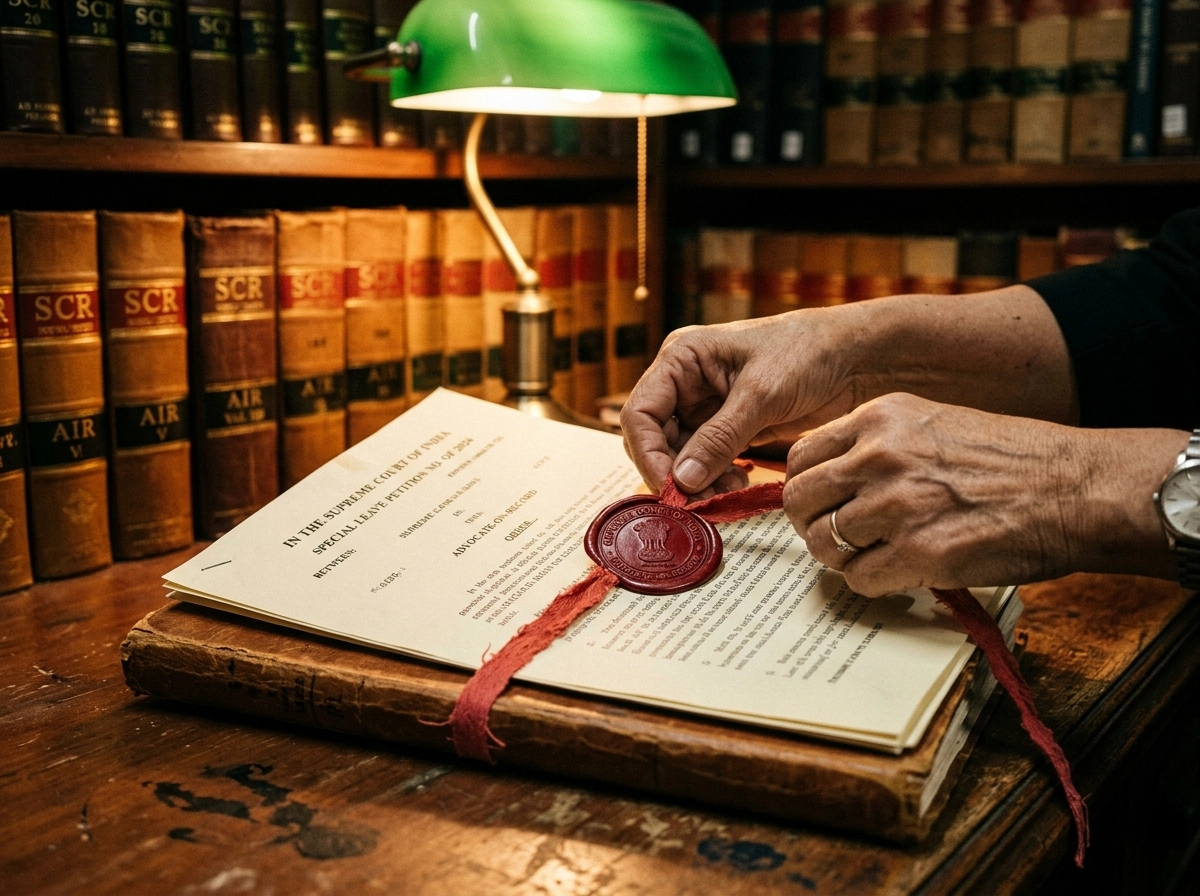
Years spent with a trusted legal team in state courts don’t prepare you for the shock of the Supreme Court’s entry requirements. Your existing lawyers can’t just walk in and file a petition. The system runs on a strict ‘Advocate-on-Record’ (AOR) mandate. It’s more than a bureaucratic hurdle. It’s a technical safeguard that keeps the apex court from grinding to a halt.
the procedural gatekeeper of the apex court
Order IV of the Supreme Court Rules, 2013, is clear: only an AOR can ‘act’ for a party. While any advocate might ‘plead’ or argue if the court allows it, the AOR alone is legally authorized to handle Supreme Court filing requirements and vouch for the record. They’ve cleared a specialized, grueling exam on procedural law. This gatekeeping ensures that defective filings don’t choke the judicial calendar. It’s about maintaining the integrity of the highest court’s docket.
distinguishing the trial lawyer from the AOR
Trial lawyers live in the ‘what’—the evidence, the witnesses, and the narrative facts. An advocate on record supreme court pivots to the ‘how’ and ‘why’ of the legal error. They are the bridge between lower courts and the apex bench. It isn’t just administrative work. The AOR frames the petition to survive the court’s brutal discretionary review standards.
The reason why hiring a local delhi high court lawyer isn’t enough for an SLP is often down to personal accountability. The AOR is personally liable to the court for procedural lapses. It’s high-stakes. This is why professionals like Shashi Kiran prioritize a meticulous approach to legal representation Delhi. Trial courts rarely demand this level of scrutiny.
Mastering the legal strategy transition determines if a petition is heard or dismissed. While the AOR works with Senior Advocates, they are the registry’s only point of contact. It’s a role requiring academic depth and a feel for the Supreme Court advocate delhi ecosystem. Sometimes, the AOR has to tell a client their ‘perfect’ evidence is dead weight at this stage. Those aren’t easy conversations, but they’re necessary.
Anatomy of an SLP: more than just a complaint
Imagine standing before a bench that has sixty cases to hear in a single afternoon. You have roughly three minutes to convince them that your case isn’t just a private grievance, but a matter of legal necessity. This is where the drafting of a Special Leave Petition (SLP) separates the veterans from the amateurs. Most people think an SLP is just another “appeal,” but it’s actually a plea for the court to use its discretion. ### The shift from storytelling to legal surgery. When I review a file, I’m not looking for the emotional “wrong” that happened at the trial level. I’m looking for the “substantial question of law.” If the draft reads like a rehash of the High Court arguments, it’s destined for the bin. The Supreme Court admission procedure is famously strict because the judges aren’t checking if the High Court was “mean”,they’re checking if the High Court was legally wrong in a way that creates a systemic ripple effect. A successful Special Leave Petition strategy involves a carefully crafted “Synopsis” and “List of Dates.” These aren’t just administrative summaries. They are the narrative hook. And yet, I’ve seen brilliant legal minds fail here because they couldn’t pivot from the “what happened” to the “why it matters legally.” If you are looking for top legal representation in Delhi’s Supreme Court for 2026, you’ll find that the best practitioners spend more time refining the “Questions of Law” than any other part of the document. But even a great story needs a solid foundation. This is why seeking Supreme Court legal advice Delhi early is so vital. The paper-book must be organized with surgical precision. One missing affidavit or an incorrectly translated document can stall the case before a judge even sees it. So, while the High Court might have tolerated some procedural slack, the apex court certainly won’t. The reality is that an advocate in Supreme Court New Delhi acts as a gatekeeper. We often have to tell clients that their “best” evidence might actually be irrelevant at this stage. It’s a hard pill to swallow, but it’s the only way to earn that rare “Notice” from the bench. This doesn’t always guarantee a win, but it guarantees you’re actually in the game.
By the numbers: surviving the 15% admission rate

By the numbers: surviving the 15% admission rate
About 80% of daily filings at Tilak Marg are Special Leave Petitions (SLPs). But here is the reality: only 10% to 15% survive that first hearing. It isn’t always about the merit of the case. Most fail because they don’t follow the Supreme Court admission procedure correctly. At this level, pointing out a simple error isn’t enough. The Court demands a clear miscarriage of justice or a legal question that affects the entire nation.
I often see clients move up from the High Court assuming a ‘strong case’ earns them a full hearing. It doesn’t work that way. Article 136 is a gatekeeper, not an open door. If your petition is just a repeat of High Court arguments, it is going to be dismissed. Fast. hiring Supreme Court counsel is about finding someone who can frame a ‘substantial question’ to tilt those 15% odds. Even the most seasoned advocates lose cases when the bench decides the matter doesn’t warrant national attention.
It is a gut punch when a matter is dismissed in under two minutes without a word of explanation. In my experience, the line between ‘dismissed’ and ‘notice issued’ is drawn in the first three pages of the SLP. You aren’t just filing a complaint. You’re proving the system failed so fundamentally that only the apex court can fix it. legal representation fees India reflect this intensity. You’re paying for the ability to boil down years of litigation into a few minutes of oral persuasion. At Shashi Kiran Advocate, we focus on why your case matters to the law itself, not just the facts.
The procedural wall: paper-books and strict deadlines
After you swallow the 15% admission rate, the next obstacle isn’t the judge’s mood. It’s the clerk’s checklist. In the Supreme Court, the procedural wall is a literal barrier where cases expire before a judge even sees them. I’ve watched airtight legal arguments fail because of a missed deadline or a minor formatting error in the paper-book. High Courts often let you fix procedural slips with a basic application, but the Apex Court’s registry is different. It’s rigid. The first hurdle is the limitation period. For most Special Leave Petitions (SLPs), you’ve got 90 days from the High Court’s judgment. While delays are sometimes forgiven, the Court’s patience has worn thin lately. If you don’t prove “sufficient cause”—and that means a real, documented emergency—the filing counter will reject your petition outright. This makes an experienced Supreme Court advocate on record mandatory. They don’t just sign papers. They protect the technical integrity of the entire filing.
The rigidity of the paper-book
Time isn’t the only constraint. There are specific Supreme Court filing requirements for the physical and digital paper-book. Font size and index structure must follow the Supreme Court Rules, 2013, exactly. This isn’t about looking good. A missing certified copy or an unverified affidavit triggers “defects” from the registry. If you don’t clear these within 28 days, the case is “consigned to the record room.” That’s legal code for game over. At the office of Shashi Kiran Advocate, we tell clients that technicality is strategy. You won’t get to the substantive law if you trip on the stairs. Many litigants are caught off-guard because they expect the flexibility of lower courts to follow them to Tilak Marg. It doesn’t. The Supreme Court operates on a frequency where precision is the only currency that matters.
What happens if the Lords say no?
Once you’ve scaled the procedural wall and finally stood before the Bench, there’s a moment of silence. When the Court says “Dismissed,” it feels like a door slamming shut. In the Indian legal system, it usually is. Most people think there’s always another appeal. But at this level, the road ends abruptly.
The doctrine of merger and finality
When the Supreme Court dismisses a Special Leave Petition (SLP) after hearing it, the High Court’s order effectively merges into the Supreme Court’s decision. This is the doctrine of merger. It means the lower court’s order no longer exists independently; it’s been absorbed by the higher court’s authority. This is why getting the Special Leave Petition process India right the first time matters so much. You don’t get a second chance to make a first impression on the law of the land.
Seeking a review: the 30-day window
Can you fight back? Yes, but don’t hold your breath. You can file a Review Petition within 30 days of the order.
But here’s the reality: it’s usually decided in the judges’ chambers without you or your lawyer present. To win, you have to prove an error apparent on the face of the record. It’s not for re-arguing your case because you think the judge was wrong. It’s for pointing out a massive, obvious mistake—like the court overlooking a specific law or a previous binding judgment. The bar for success is set high.
The absolute last resort: curative petitions
If a review fails, you’re looking at a curative petition. This is the rarest of remedies. This isn’t just about being right. You have to prove a violation of natural justice so severe it shocks the court. Honestly, these almost never work unless there’s a clear case of bias or the party wasn’t heard at all.
This finality is why hiring Supreme Court counsel like the team at Shashi Kiran Advocate is a smart move. You aren’t just paying for a voice in court. You’re paying for the wisdom to know if a case even has the legs to survive the initial “no.” If you’re seeking Supreme Court legal advice Delhi, remember that the end of the road is closer than you think. The real skill lies in making that one shot count, rather than planning for a miracle in a curative plea.
If you are worried about your case moving to the apex court, Advocate Shashi Kiran provides the specialized guidance you need to navigate these high-stakes filings.
Frequently Asked Questions
Can I just use my local lawyer for a Supreme Court filing?
Honestly, no. You’re required by law to engage an Advocate-on-Record (AOR) to file documents in the Supreme Court. They’ve passed a specific, rigorous exam to handle these filings, and it’s a technical necessity you can’t bypass.
Why does the Supreme Court often dismiss cases without a long explanation?
It’s because their jurisdiction under Article 136 is discretionary. They aren’t there to re-hear every case; they’re looking for substantial questions of law or major miscarriages of justice. If your petition doesn’t hit those specific notes, they’ll often dismiss it quickly.
Is it possible to re-argue the facts of my property dispute in the Supreme Court?
That’s a common mistake, but it’s usually a dead end. The Supreme Court isn’t a third round of trial where you get to re-weigh evidence. You’ll need to pivot your argument to focus on how the law was applied incorrectly or why a constitutional issue is at play.
What happens if my Special Leave Petition is rejected?
It’s usually the end of the road for that specific matter. While there are rare options like review or curative petitions, they’re extremely difficult to win. That’s why it’s so important to get the initial SLP filing right the first time.