
The fundamental divide between fact-finding and legal interpretation
Ever watched a cross-examination that felt like a high-stakes chess match? In the Delhi High Court, that’s the norm. Judges there care about who said what and which document got signed. It’s the core of the case. But try that in the Supreme Court? You’ll lose the room fast. The Supreme Court doesn’t want to be a “third court of fact.” They aren’t there to re-examine the messy details of what happened on a Tuesday afternoon. They want the logic behind the law.
The shift from “what happened” to “is it legal”
When you’re in Delhi High Court litigation, the bench acts as a court of record. They weigh evidence. They judge if a witness is lying. It’s a grind.
But the apex court is different. They assume the facts are already settled. Unless there’s a massive error, they won’t look at them again. Instead, they’re hunting for a “substantial question of law.” They want to know if the lower court got the Constitution or a statute wrong.
I’ve seen litigants fall into this trap constantly. People think a killer witness statement from the High Court will save their Special Leave Petition (SLP). It won’t. If you’re hiring a supreme court lawyer, they’ll be blunt: re-arguing facts usually leads straight to a dismissal. Sure, there are exceptions—like criminal appeals where a life is on the line—but those are the outliers.
Why tactics don’t always travel well
This is why legal representation differences are a big deal. A strategy that wins in the High Court by poking holes in a forensic report might be useless upstairs. The higher you go, the more abstract it gets. You’re no longer just fighting for your own win. You’re often arguing about a rule that could affect millions of people. It’s a different game entirely.
Where the Delhi High Court gets into the weeds
The granular reality of the Delhi High Court
Unlike the Supreme Court, which rarely looks at a witness statement unless it’s to point out a glaring legal error, the Delhi High Court lives in the minutiae. If you’re involved in a commercial suit or a probate matter, your delhi high court lawyer isn’t just arguing law; they’re managing the ‘Original Side’ reality where facts are born. This is where the rubber meets the road. In the High Court, we don’t just talk about what happened; we prove it through a rigorous process of recording evidence that can stretch for months.
One of the biggest court procedural differences involves the use of Local Commissioners. Under the Delhi High Court (Original Side) Rules, 2018, the court often appoints a commissioner to record cross-examinations outside the courtroom. It’s a grind. I’ve seen cases where the entire outcome hinged on a single admission during a late-evening session in a commissioner’s office. If your counsel isn’t prepared for these legal procedural delays or the tactical nuances of witness handling, the best legal arguments in the world won’t save a crumbling factual foundation.
Even on the appellate side, the High Court’s job is to re-appreciate the evidence. It’s a ‘first appeal,’ meaning the judges are duty-bound to look at the trial court’s findings with a fresh pair of eyes. They check if the admissibility of electronic evidence was handled correctly or if a witness was actually credible. This is why high court lawyers delhi focus so heavily on the ‘paper book’,the thick stack of documents that contains every transcript and exhibit. It’s a stark contrast to the Supreme Court, where top supreme court lawyers in delhi must pivot away from these details.
I often tell clients that moving from the High Court to a Special Leave Petition is like moving from a microscope to a telescope. In the High Court, we’re looking at the cells; in the Supreme Court, we’re looking at the horizon. But if the cells are diseased, the telescope won’t help. Whether you are consulting a family law advocate delhi for a matrimonial dispute or criminal lawyers in delhi supreme court for a bail matter, the strategy has to account for this transition.
You need to secure high caliber legal representation that understands when to fight over a comma in a witness statement and when to let it go. And yes, understanding supreme court advocate fees is part of that strategic planning, as the shift in focus requires a different kind of intellectual heavy lifting. Ultimately, you have to ask: does your lawyer have standing to handle both the granular facts and the high-level law?
The Supreme Court is not a ‘trial court of second appeal’
If you’ve just finished arguing about specific signatures or conflicting dates in the High Court, stop. The Supreme Court isn’t a place for repeats. Most litigants think they’re getting a “second chance” at a trial. They’re wrong. The apex court is not a trial court of second appeal. Period.
Why the Supreme Court rejects factual re-arguments
The Supreme Court’s mandate is mostly about “substantial questions of law.” If two courts below—the trial court and the High Court—already agreed on a fact, the Supreme Court won’t touch it. This is the “concurrent findings of fact” rule. To break it, you need a sharp supreme court advocate in delhi who can show the findings are perverse or based on no evidence at all. It’s a high bar that most people underestimate.
But that’s rare. This is why a legal strategy transition is non-negotiable. While lawyers in supreme court delhi might look at the same case file, they’re hunting for different things. They aren’t looking to re-examine a witness. They’re looking for where the High Court misapplied a statute or ignored a binding precedent.
I’ve seen cases fail because counsel tried to re-argue the credibility of a witness. That’s a losing game. The Supreme Court expects you to respect the special procedure of the high court regarding how evidence was recorded and signed. Unless there’s a shock to the judicial conscience, those records are final.
So, do you need a different legal mind for this? Honestly, yes. You need someone who knows what to ask your lawyer before moving an appeal so you aren’t just wasting money on a filing that goes nowhere.
Hiring a supreme court advocate means finding someone who can shift gears. You’re no longer proving “what happened” on that Tuesday in 2018. You’re proving why the High Court’s interpretation of the law was wrong. It’s a shift from storytelling to legal logic. That’s where you win.
When electronic records become the battleground
In 2020, the Supreme Court’s ruling in Arjun Panditrao Khotkar v. Kailash Kushanrao Gorantyal finally mandated that a Section 65B(4) certificate is a non-negotiable condition precedent for the admissibility of secondary electronic evidence. This decision effectively ended years of procedural ambiguity that plagued lower courts. While the Delhi High Court often allows for the ‘curing’ of such defects during the trial or appellate stage, the Supreme Court views the absence of this certificate as a fundamental legal lapse that can dismantle an entire case.
At the High Court level, the battle is usually over the authenticity of the data itself. You’ll find the best Delhi High Court advocate meticulously verifying hash values, metadata, and the source of the digital trail. They work within the ‘original’ jurisdiction where the physical production of the certificate is a procedural milestone. If a certificate is missing, the High Court might allow a party to file it later, provided the trial is still active or under specific appellate circumstances. It’s a messy, fact-heavy process where the focus is on whether the record is genuine.
The shift in legal strategy transition
But the Supreme Court doesn’t want to hear about the contents of the WhatsApp chat; it wants to know if the legal mandate of Section 65B was followed. This requires a significant legal strategy transition because you aren’t just proving a fact,you’re defending the process. In my work at Shashi Kiran Advocate, I’ve seen cases fall apart simply because the electronic trail wasn’t properly certified at the start. If the High Court admitted a piece of evidence without the mandatory certificate, the best lawyers in Delhi Supreme Court will target that admission as a perversity in law. They frame the error not as a minor oversight, but as a violation of the law of evidence that invalidates the lower court’s findings.
Why the certificate matters in practice
The reality is that digital evidence is volatile. Without the strict safeguards of Section 65B, a screenshot or a call recording could be easily manipulated. While the High Court might be lenient due to the ground realities of trial litigation, the Supreme Court maintains a high bar to prevent potential miscarriages of justice. It’s not always about what the evidence says, but whether the law permits the court to look at it in the first place. Sometimes, even with the certificate, the Supreme Court might question the ‘contemporaneous’ nature of the filing if it wasn’t handled correctly at the start. This is why understanding the cost and procedural implications of these technicalities is vital for any litigant.
Navigating the AOR gatekeeper and procedural rigor
Imagine you’ve spent years navigating the gritty details of a property dispute at the Delhi High Court. You’ve mastered the witness statements and the electronic trails discussed previously. But once that case moves to Tilak Marg, the rules change. You can’t just walk in with your existing team and expect the same workflow. The Supreme Court operates under a unique “gatekeeper” system known as the Advocate on Record (AOR).
An AOR isn’t just a lawyer who passed a bar exam; they’ve cleared a rigorous, specialized examination set by the Court itself. They are the only professionals legally permitted to file matters and “act” on behalf of a litigant. This isn’t just bureaucracy; it’s a filter for procedural quality. When you’re hiring a supreme court advocate in india, you aren’t just looking for an orator. You’re looking for someone who ensures your petition isn’t dismissed on a technicality before a judge even reads the first page. Honestly, even the strongest legal arguments can fail if the procedural foundation is shaky.
I’ve seen many brilliant High Court lawyers struggle because they didn’t account for the Supreme Court Rules, 2013. These rules dictate everything from the font size to the specific way an affidavit is sworn. A seasoned supreme court advocate like Shashi Kiran, who has spent over three decades navigating these corridors, understands that the Court relies on the AOR’s personal accountability. If there’s a mistake in the filing, the AOR is the one held responsible. This accountability creates a standard that keeps the highest court from being bogged down by sloppy paperwork. It’s a transition from arguing “what happened” to proving “why this matters legally,” and the AOR is the pilot for that shift.
Avoid the trap of re-arguing witness credibility
The futility of questioning witness demeanor
Trying to convince a Supreme Court Justice that a witness was “lying” or “shifty” is a fast track to a dismissed petition. It is a hard truth for many litigants to swallow. In the Delhi High Court, you have the luxury of dissecting the trial record and pointing out inconsistencies in cross-examination. But the Supreme Court isn’t a third-tier trial court. It is an appellate body that respects the findings of fact already established by lower benches.
Most litigants fail because they don’t understand the legal strategy transition required at this level. If two lower courts have already agreed that a witness is credible, the Supreme Court will rarely interfere. They aren’t interested in the “he said, she said” of the original dispute. And they certainly won’t re-examine the witness’s body language or tone. They care about whether the law was applied correctly to the facts on record. If your argument rests on the credibility of a single individual, you’ve already lost the room.
Choosing the right representative is about identifying this specific skill set. When you look at how to find the best supreme court advocate in delhi for your urgent needs, you aren’t just looking for someone with a high success rate. You’re looking for someone who understands that the difference between high court and supreme court lawyer lies in the ability to abandon dead-end factual arguments in favor of high-level legal theory.
But some cases do have factual errors so egregious they constitute “perversity.” That’s the only narrow window you have. And even then, you don’t argue that the witness was bad. You argue that the lower court’s reliance on that witness was legally untenable. It’s a subtle but vital distinction. Don’t waste your limited time in front of the bench trying to redo the trial. Focus on the law, or don’t bother filing.
Making the jump from Sher Shah Road to Tilak Marg
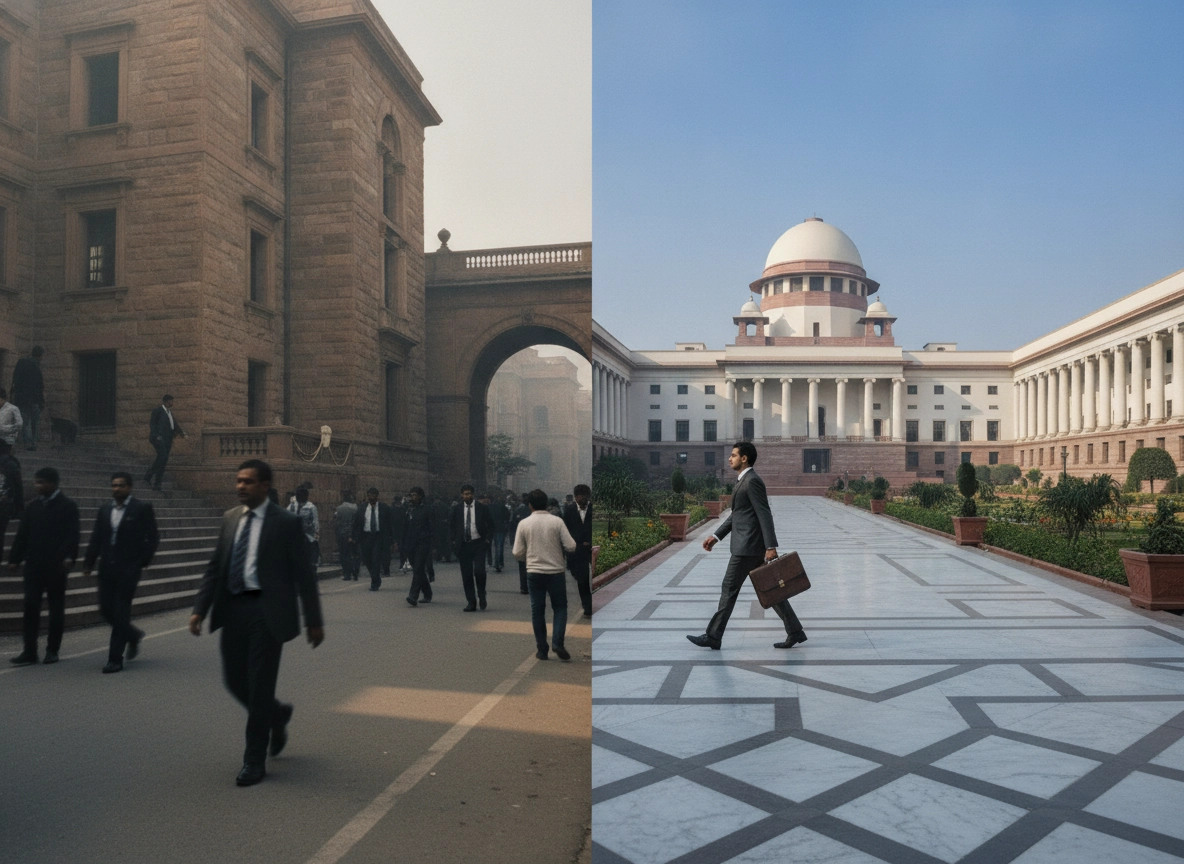
The physical distance between Sher Shah Road and Tilak Marg is barely three kilometers, but the strategic gap is a canyon. If you’ve spent years at the Delhi High Court debating whether a witness was lying or if a specific email was tampered with, you’re in for a shock. The Supreme Court doesn’t have the patience for those ‘he-said, she-said’ nuances. It’s looking for something much rarer: a substantial question of law that affects more than just your specific case.
The shift from what happened to why it matters
You can’t simply recycle your High Court brief and hope for the best. I’ve seen countless litigants make the mistake of treating the apex court as a ‘third trial.’ They walk in ready to re-argue the credibility of evidence, only to find their petition dismissed in under three minutes. To succeed here, you have to stop asking “What happened?” and start asking “What is the legal principle at stake?”
This transition is exactly why hiring a supreme court advocate in india isn’t just about finding a senior name; it’s about finding a strategist who understands the Advocate-on-Record (AOR) system. A skilled delhi high court lawyer might be a brilliant cross-examiner, but that skill set is almost irrelevant in the Supreme Court where no new witnesses are called.
Shashi Kiran often notes that the most successful Special Leave Petitions (SLPs) are those that frame the issue as a systemic legal error rather than a factual grievance. It’s a specialized craft that requires an AOR’s eye for procedural rigor and a constitutional lawyer’s eye for precedent. Don’t just carry your old arguments across the road,rebuild them for the higher altitude of Tilak Marg. The real question isn’t whether you were wronged, but whether the law itself was misapplied in a way that demands the nation’s highest intervention.
If you’re unsure how to pivot your case for the Supreme Court, Advocate provides the specialized counsel needed to navigate the transition. Reach out today for a consultation at +91-92121-97427.
Frequently Asked Questions
Can I re-argue my witness testimony in the Supreme Court?
Honestly, you shouldn’t count on it. The Supreme Court isn’t a trial court, so they rarely re-examine witness credibility or factual findings that lower courts have already settled.
Why is the Advocate-on-Record (AOR) system so strict?
It’s there to ensure procedural quality. Since the Supreme Court handles national-level legal issues, the AOR system acts as a gatekeeper to keep filings consistent and technically sound.
Does the Supreme Court ever look at evidence like the Delhi High Court does?
They focus on substantial questions of law rather than the ‘he-said, she-said’ of trial evidence. Unless there’s a major legal error in how evidence was admitted, they’ll usually stick to the facts as established by the lower courts.
How do I know if my case is ready for the Supreme Court?
If your case hinges on a constitutional point or a conflicting interpretation of law, it’s likely ready. If you’re just hoping to get a second opinion on the facts, you’ll probably find the Supreme Court isn’t the right venue.


